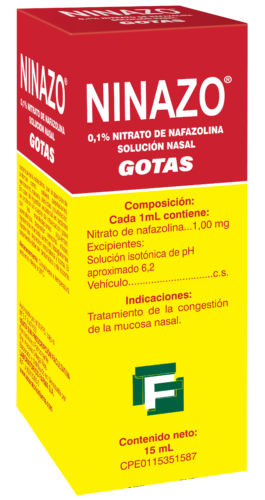
Ninazo ®

naphazoline nitrate 1 mg
Ninazo® is a local nasal decongestant that relieves nasal congestion caused by colds, tobacco smoke, environmental pollution, sudden changes in temperature or due to inhalation or irritating substances.
Nasal congestion is caused by the inflammation or edema of the nasal tissue due to dilation (increased diameter) of the blood vessels that leads obstructions and difficulties breathing due to resistance to the air being aspirated through the nose.
The clinical signs are nasal obstruction and problems breathing through the nose. Due to the inflammation of the nasal tissue, the patient may also show increased secretion of mucus (rhinorrhea).
Insofar a possible avoid cigarette smoke, environmental pollution, sudden changes of temperature or inhalation of irritating substances as all these may cause or exacerbate nasal congestion.
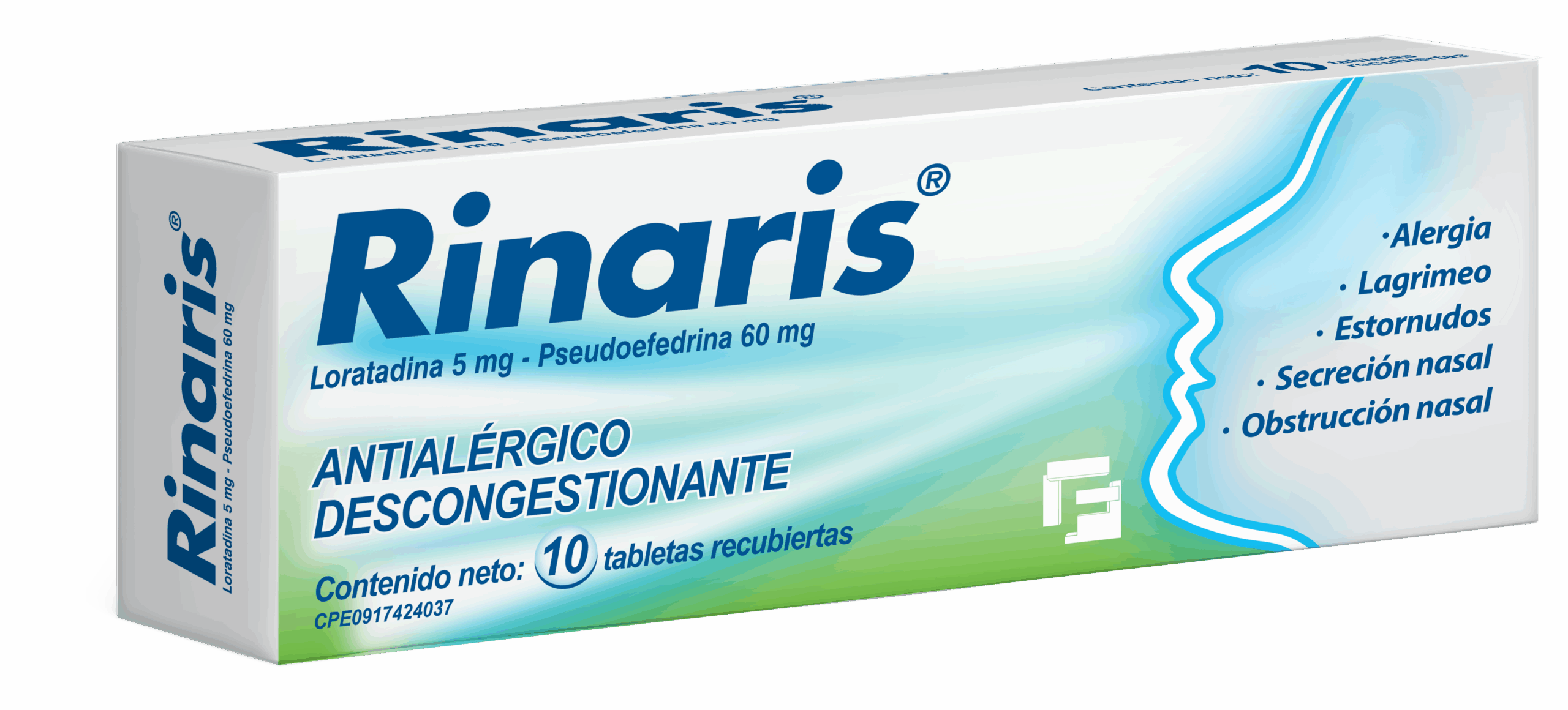
Rinaris ®
loratadine 5 mg – pseudoephedrine 60mg
Rinaris® is a dual action treatment that does away with the symptoms of allergic rhinitis and nasal congestion without causing drowsiness, allowing the patient to breathe easily and improving quality of life.
Children over 12 years old and adults: one (1) tablet every 12 hours for no more than three (3) days.
Rhinitis refers to an inflammation of the nasal tissue (internal layer of the nostrils). The symptoms are nasal congestion (feeling that nose is stuffy), sneezing, itching or prickling in the nose and increased secretion (rhinorrhea).
The symptoms of rhinitis are nasal congestion (stuffy nose), sneezing, itching or prickling in the nose and increased secretion (rhinorrhea).
It is important that patients faced with this problem follow the recommendations listed below:
Rinaris® helps relieve the symptoms of allergic rhinitis, with the advantage that it contains both an antiallergic drug and a decongestant, providing faster relief of the symptoms. As for how it should be taken: for children over 12 and adults, one (1) tablet every 12 hours for no more than three (3) days.
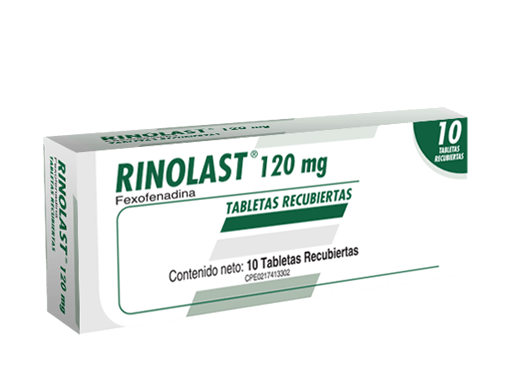
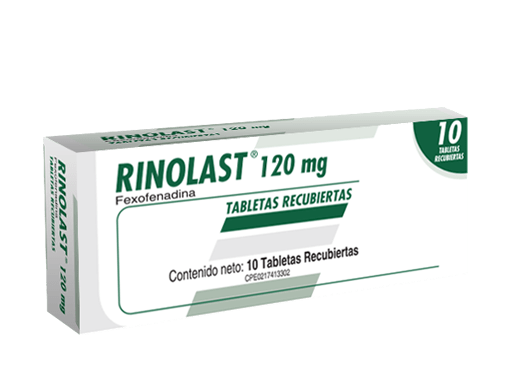
Rinolast ®
fexofenadine
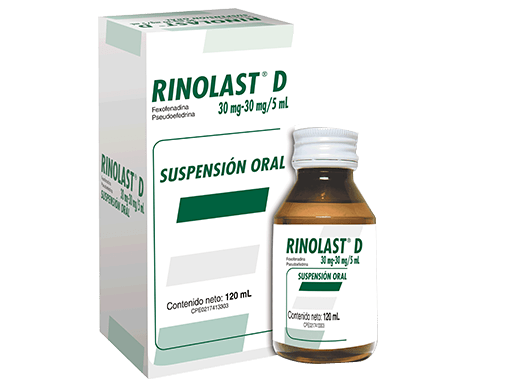
Rinolast® D
fexofenadine – pseudoephedrine
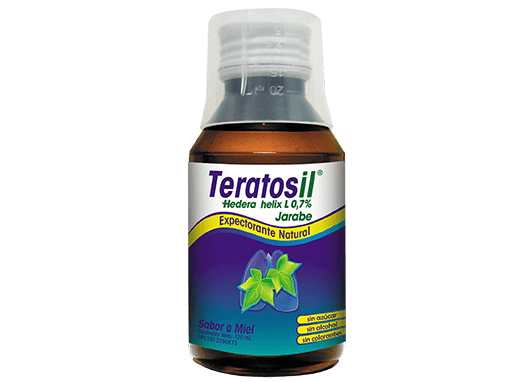
Teratosil ®

hedera helix
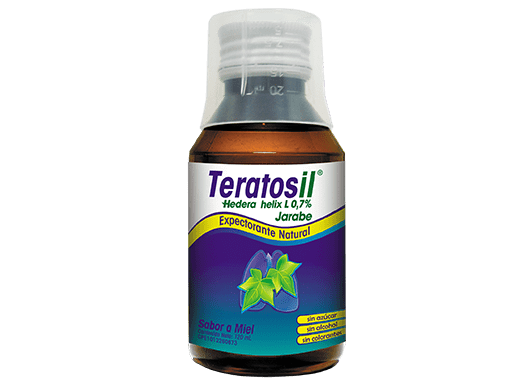
Teratosil® is a natural ivy-based expectorant used to relieve coughing with phlegm.
Children from 2 to 5 years old: 2.5 ml (1/2 teaspoon) 3 times a day. Children from 6 to 12 years old: 5 ml (1 teaspoon) 3 times a day. Children over 12 and adults: 7.5 ml (1-1/2 teaspoons) 3 times a day.
Coughing is a natural reflex of the body whose purpose is to protect the lungs. Coughing helps clear the respiratory system of elements that irritate the lungs (such as mucus) to help ward off infection. There are different types of cough. A cough may be dry or wet (people sometimes refer to a wet cough as a bronchial cough) and may, in turn, be productive (in other words that produces mucus) or unproductive (in other words, that does not produce mucus). A bronchial cough is generally productive, whereas a dry cough is not.
DRY COUGH: Not associated with excessive phlegm, it is probably caused by irritation. A dry cough can be treated with cough suppressants, such as dextromethorphan. BRONCHIAL COUGH: It may be productive or unproductive. An excessive amount of phlegm in the lungs and respiratory system prompts a bronchial cough and the patient may have problems bringing up the phlegm and clearing the respiratory system. A bronchial cough is generally treated with an expectorant that helps thin the phlegm and make the cough more productive. Treatments with ivy (hedera helix) are the most commonly used.
There are many factors that can cause a cough. Coughing generally occurs when the nerve endings in the respiratory system become irritated. This may be due to a viral infection that causes a cold or the flu. When external factors make their way into the respiratory system, the body reacts with the cough reflex to clear the airways and protect the lungs. Extraneous object in the airways, inhalation of irritants (smoke), excessive mucus, etc.
The best way to treat a cough is to begin by identifying what type of cough it is. If the cough is accompanied by phlegm, you probably have a productive or wet cough. To treat a wet cough you can use a non-prescription ivy-based expectorant that helps thin the mucus and make the cough more productive. To treat a dry cough you may use a cough suppressing medication.